Browse

Log in / Register
 Share

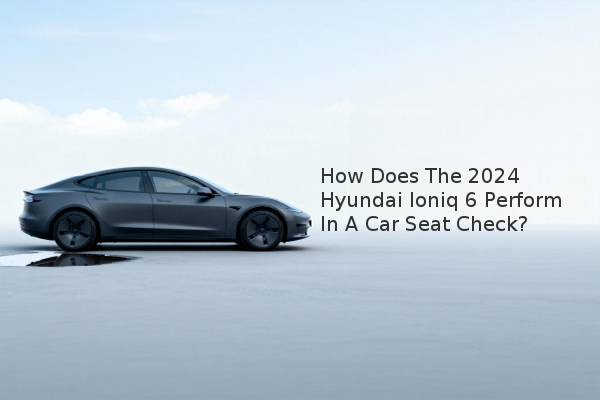
Based on our expert assessment, the 2024 Hyundai Ioniq 6 earns solid B grades for installing most child safety seats, with its main challenge being difficult-to-access lower Latch anchors. While roomy for two car seats, it cannot comfortably accommodate three.
For families considering an electric vehicle, a crucial question is how it will handle the practicalities of daily life, especially transporting children. A key part of that evaluation is a thorough car seat check. We've put the 2024 Hyundai Ioniq 6 through a rigorous assessment to see how it measures up, grading the installation process for infant, convertible, and booster seats.
The Latch system (Lower Anchors and Tethers for Children) is a standardized set of anchors in vehicles designed to simplify and secure child safety seat installation without using the seat belt. In the Ioniq 6, this system receives a B grade.
The three top tether anchors on the rear shelf are clearly marked and simple to use. However, the lower anchors are not exposed and are positioned deep within the seat bight—the crease where the seatback and bottom cushion meet. The firm upholstery requires some effort to push the connector through, and the tight space offers little room for maneuvering your hands, making connection more challenging than in some rival sedans.
Installing a rear-facing infant seat also earns a B grade. The primary challenge remains connecting to the lower Latch anchors due to their placement. Once correctly installed, the seat itself fits very well and securely. An important positive note for front-seat passengers: even with the infant seat behind the front passenger seat, a person who is 5-foot-6 had ample legroom, indicating the rear cabin is reasonably spacious despite the sedan's sleek, compact exterior.
The Ioniq 6 earns another B grade for the rear-facing convertible seat installation. The experience mirrors that of the infant seat: the initial connection to the lower anchors is the main difficulty. Once installed properly, the car seat is stable and secure. Importantly, it did not necessitate moving the front passenger seat forward significantly, preserving comfort for the adult occupant.
The forward-facing convertible seat installation presents an additional step but still results in a B grade. Due to the sedan's sloping roofline—a design feature for aerodynamic efficiency—you must fold the rear seatback forward to access and remove the head restraint before installation. After the head restraint is removed, the forward-facing seat can be positioned flush against the seatback. Connecting the top tether anchor is straightforward, but connecting the lower anchors is again the most labor-intensive part of the process.
The Ioniq 6 performs best with a high-back booster seat, earning an A grade. After removing the corresponding head restraint, the booster fits perfectly. The vehicle's outboard seat belt buckles are mounted on short, firm stalks, making it easy for a child to grasp and fasten independently. A point to note: the center seat buckle is a floppy, fabric-based design, which some children might find more challenging to use on their own.
No, the 2024 Hyundai Ioniq 6 cannot reliably fit three car seats across its second row. While it is sufficiently roomy for two car seats, the width of the cabin and the design of the seating positions do not allow for three child safety seats to be installed side-by-side safely and practically.
To ensure a safe installation in the 2024 Hyundai Ioniq 6, remember these key points: