Browse

Log in / Register
 Share
Share
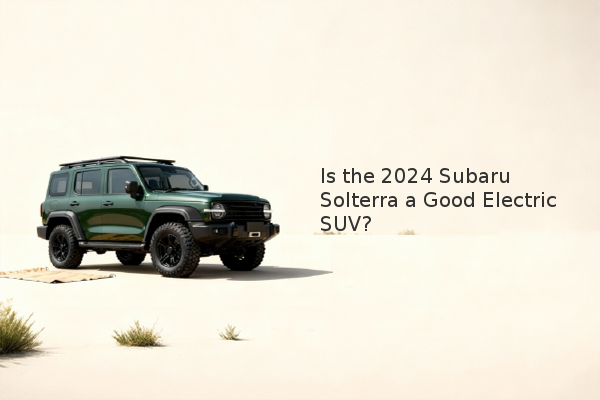
The 2024 Subaru Solterra is a competent but unremarkable entry into the electric SUV market. As Subaru's first all-electric vehicle, it serves as a pragmatic stopgap rather than a groundbreaking model. It shares its core design with the Toyota bZ4X, offering standard all-wheel drive and decent daily driving manners. However, its below-average driving range and slower charging speeds place it behind key rivals like the Ford Mustang Mach-E, Hyundai Ioniq 5, and Tesla Model Y. Based on our assessment experience, it's a reasonably well-rounded compact SUV for Subaru loyalists making the switch to EV, but it faces stiff competition.
The Solterra's sole powertrain consists of dual electric motors producing a combined 215 horsepower and 249 pounds-feet of torque. This provides respectably zippy acceleration, making it easy to merge onto highways and navigate city traffic. The instant torque delivery typical of electric vehicles is present and effective.
The vehicle features driver-selectable regenerative braking intensity. This system captures kinetic energy during deceleration and feeds it back to the battery. The strongest setting nearly allows for one-pedal driving, where lifting off the accelerator significantly slows the car, though you'll still need the brake pedal to come to a complete stop. A notable quirk is that the system defaults to the weakest setting every time the car is started, requiring the driver to readjust it via steering-wheel paddles.
In terms of driving dynamics, the suspension is tuned for comfort, not sporty handling. You feel the vehicle's considerable weight in corners, but the handling remains composed and predictable. Ride quality is decent, even with the available 20-inch wheels, though some tire roar on certain freeway surfaces can be intrusive.
This is the Solterra's most significant drawback. Its 72.8-kilowatt-hour (kWh) battery delivers an EPA-estimated range of 227 miles for the base Premium trim and 222 miles for the Limited and Touring trims. In real-world testing, a fully charged Touring model displayed a range between 217 and 225 miles, confirming the EPA rating.
The following table illustrates how the Solterra's range compares to all-wheel-drive versions of its main competitors:
| Electric SUV Model | EPA-Estimated Range (AWD) |
|---|---|
| Tesla Model Y Long Range | 310 miles |
| Ford Mustang Mach-E Extended Range | 300 miles |
| Kia EV6 (with 19-inch wheels) | 282 miles |
| Hyundai Ioniq 5 | 260 miles |
| Subaru Solterra Touring | 222 miles |
For 2024, Subaru improved the DC fast-charging performance. The company states the time to charge from 10% to 80% battery capacity is now as little as 35 minutes, a significant improvement from the previous 60 minutes. However, this is still slower than rivals with 800-volt architecture, like the Ioniq 5 and EV6, which can achieve the same charge in under 20 minutes under ideal conditions.
The cabin is spacious for both front and rear passengers, and cargo space is generous with a low, wide load floor. The rear seats fold nearly flat for larger items. However, the interior has several distinct quirks.
Pricing is competitive with similar AWD electric SUVs, but you get less range for your money. The lineup is simple:
The Solterra's value proposition hinges on its standard all-wheel drive and Subaru's reputation for practicality. It is a capable daily driver with sufficient space for families. However, its compromised range and charging speed are significant factors to weigh against competitors that offer more advanced technology and superior efficiency.